

Go For Broke
This Veterans Day weekend, Go For Broke, the movie telling the origin story of the 100th Infantry Battalion and the 442nd Regimental Combat Team premieres at the Hawaii International Film Festival. The premiere closes out the festival on Sunday, November 12.
The Champagne Campaign
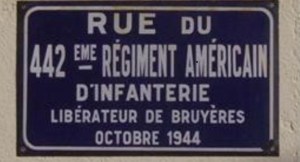
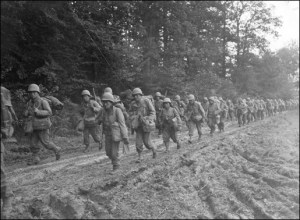
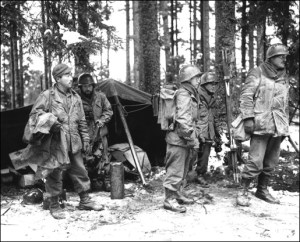
Following the fierce fighting in the forests of northeast France, the 442nd were sent south to the Maritime Alps and the Riviera. The unit needed rest and reinforcements. It was less than half its strength with close to 2,000 men in hospitals. Eventually about 1200 replacements arrived from the United States and about 250 men were released from hospitals to rejoin their units. The objective was to guard a stretch of the French-Italian border and to prevent the Germans from breaking through into southern France.
From mid-November, 1944, to mid March, 1945, the 442nd engaged in what became known as “the Chanpagne Campaign.” While there was fighting, which resulted in injuries and loss of life, the fighting was nothing like the Vosges campaign. The men were able to visit the beaches, the casinos, the nightclubs and restaurants of the region. They were able to bask in the hospitality of the French citizens.
It was a welcome respite from the intense fighting they had experienced and the fighting to come.
Medal Of Honor
Hayashi, Joe J.
Born: August 14, 1920, Salinas, California
Died: April 22, 1945, Tendola, Italy
Rank: Sergeant
Unit: 442nd Regimental Combat Team
Hayashi was a mechanic before the war. He enlisted in the Army in May 1941. After war broke out, he volunteered for the 442nd. In April, 1945, the 442nd returned to Italy for combat. Near Tendola, Hayashi exposed himself to enemy fire to direct mortar fire on enemy positions. Two days later, he single-handedly silenced three enemy machine gun positions, but was killed in pursuit of enemy soldiers.
Medal Of Honor Citation
Private Joe Hayashi distinguished himself by extraordinary heroism in action on 20 and 22 April 1945, near Tendola, Italy. On 20 April 1945, ordered to attack a strongly defended hill that commanded all approaches to the village of Tendola, Private Hayashi skillfully led his men to a point within 75 yards of enemy positions before they were detected and fired upon. After dragging his wounded comrades to safety, he returned alone and exposed himself to small arms fire in order to direct and adjust mortar fire against hostile emplacements. Boldly attacking the hill with the remaining men of his squad, he attained his objective and discovered that the mortars had neutralized three machine guns, killed 27 men, and wounded many others. On 22 April 1945, attacking the village of Tendola, Private Hayashi maneuvered his squad up a steep, terraced hill to within 100 yards of the enemy. Crawling under intense fire to a hostile machine gun position, he threw a grenade, killing one enemy soldier and forcing the other members of the gun crew to surrender. Seeing four enemy machine guns delivering deadly fire upon other elements of his platoon, he threw another grenade, destroying a machine gun nest. He then crawled to the right flank of another machine gun position where he killed four enemy soldiers and forced the others to flee. Attempting to pursue the enemy, he was mortally wounded by a burst of machine pisto fire. The dauntless courage and exemplary leadership of Private Hayashi enabled his company to attain its objective. Private Hayashi’s extraordinary heroism and devotion to duty are in keeping with the highest traditions of military service and reflect great credit on him, his unit, and the United States Army.
Volcanos
After a hearty supper we waited until it was thoroughly dark and then started to the crater. The first glance in that direction revealed a scene of wild beauty. There was a heavy fog over the crater and it was splendidly illuminated by the glare from the fires below.”
—Mark Twain, Roughing It, 1866.

Kilauea Caldera
The Big Island of Hawai‘i is made up of three volcanoes. Mauna Loa is the world’s largest mountain. Mauna Kea is the world’s tallest.The third, Kilauea, has been in continuous eruption since October 1982, the month our son Michael was born.
Volcano House, on the rim of Kilauea Caldera, facing Haleuma’umu’a crater is the oldest hotel in Hawai’i, dating back to 1846. The hotel was already in its second reincarnation when Twain visited in 1866. The current structure was built in 1941 and remains the only public accommodation inside Hawai‘i Volcano National Park.
The hotel looks right into the glowing caldera. At night you can see the fountains of lava inside. You can wake up in the morning to a rainbow rising from the crater.

Pele by Herb Kawainui Kane
In Hawaiian mythology, Haleuma’umu’a is home to Pele, the goddess of fire and the shaper of all things. Read more about Pele here.
Pahoa
Between Hilo and Volcano National Park is the small town of Pahoa. It’s a small, rural community that has attracted a lot of people who just want to get away from urban life and live simply. In the 60’s and 70’s, we would have called them hippies. As a result, the town is full of quaint shops and restaurants. It was also the location of one of the KEEP (Kamehameha Early Education Program) dissemination schools in the 70’s. Pahoa Elementary housed grades K-3 of the KEEP program and my assignment at KEEP was to evaluate the dissemination programs. I made several trips to the school to collect data. It looks much the same as it did back then. Some of the subdivisions near Pahoa were buried by lava flows from Kilauea, but the town itself was spared.
Lehua and Ohia
 The goddess Pele, she of the volcano, is the most powerful force on the the Big Island. Everywhere and everything has some connection to Pele mythology. One of the more charming myths is the legend of the Ohia tree and the Lehua flower. The Ohia grows on the lava fields. It is a pioneer, one of the first forms of vegetation to appear on the flow. It starts the process of breaking the lava into soil. Everywhere on the lava flows you can see an Ohia tree and its beautiful red flower, the Lehua.
The legend goes that Pele fell in love with a handsome warrior named Ohia, but Ohia had already pledged his love to Lehua. This so enraged Pele that she turned him into a 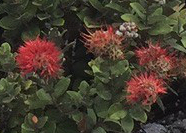 twisted tree. Lehua came looking for him. When she saw the tree, she immediately guessed what happened. Distraught and in tears, she appealed to the other gods to reverse the spell. The other gods were moved by Lehua, but feared angering Pele. Instead they changed Lehua into a flower on the tree so the two would be joined forever. Some people believe that plucking the Lehua flower will bring rain on that day, presumably Lehua’s tears.




 Magnum was just beginning its first season when we moved to Hawai‘i, so we followed it from the beginning all the way to the end. Magnum with his eyebrows, mustache, and awesome aloha shirts, Higgins, his uptight nemesis, T.C. Calvin, the helicopter pilot, and Rick Wright, the manager of the Kamehameha Club. The Kamehameha Club, but the way, was actually the Outrigger Canoe Club in Waikiki.
 The problem with the Higgins role is that it was already a central one. Moreover, I hope they don’t repeat Higgins’s stuffiness because I hate to see that in a female character. I’d rather see the T.C. role go to a woman. As with Kono, I think a woman could really elevate that role, especially a black actress.

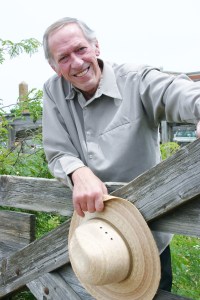 My guest today is Fort Worth mystery author, Earl Staggs. Earl is the author of two novels, Memory Of A Murder and Justified Action, both of which have earned all Five Star reviews. He is a two-time recipient of the Derringer Award for Best Short Story of the Year. He served as Managing Editor of Futures Mysterious Anthology Magazine and as President of the Short Mystery Fiction Society. Fans can find him at conferences and seminars where he is a frequent speaker. I’ve known Earl for many years and have been privileged to follow his career through many novels and stories. I, along with many others, have been delighted to meet the many characters he has created for us.



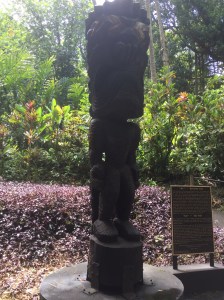 Just north of Hilo is the Hamakua Coast, an area of rainfall averaging 84 inches per year producing lush vegetation overlooking craggy sea cliffs and narrow bays with pounding surf. There are not many beaches along this part of Hawai‘I, but the views are spectacular. The area used to be the heart of the Big Island’s sugar cane production. Now the cane has gone, leaving quaint little towns that are struggling for the tourist trade.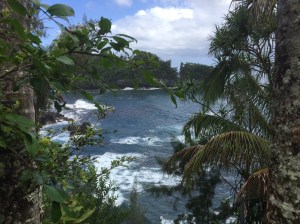
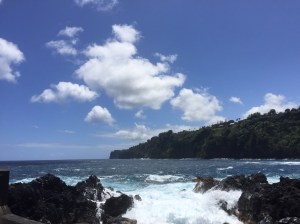
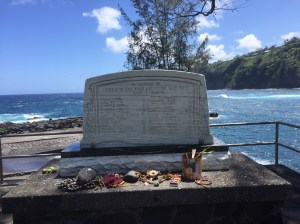 Laupahoehoe was on the railroad that transported sugar cane from the plantations to the sugar mills and to Hilo. The railroad and part of the town were wiped out in a massive tidal wave on April 1, 1946. Twenty-six people died, twenty-one of them school children. The school was completely inundated. The tidal wave was the result of an earthquake in the Aleutian Islands. It was the most destructive tidal wave ever seen in the Island of Hawai‘I. Down at the beach park is a monument to the individuals who died in the wave and to the acts of bravery that save other lives. The tidal wave did damage and claimed lives at other parts of the island, including Hilo. In total, 160 people died in what came to be known as the April Fool’s Tidal Wave.


 You can’t visit Hawai‘I without experiencing a Hawaiian plate which you can find at drive inns on every island. Verna’s Drive Inn in Hilo is one such place. It’s fairly typical in its menu and it’s service. There is no indoor dining, but you can eat at one or two tables outside. Most people prefer to eat elsewhere—home or the beach. There is no drive up window. You walk up to the window on which is taped the extensive menu. There are breakfast offerings such as Spam and eggs, or loco mocos. There are fast food offering such as burgers, hot dogs, fries. Best of all are the Hawaiian plate or plate lunch offerings. These usually include one or two meats such as shoyu chicken, roast pork, kalua pork, kalbi beef, mahi mahi, lau lau, and more. Each plate comes with two scoops of rice and a scoop of macaroni salad. Kimchi is usually extra. Mega calories. We had one plate which fed both of us for two meals.

 The Ficklings describe Honey as a combination of Marilyn Monroe (who was also seen as a bimbo, but was not) and Mike Hammer. Richard S. Prather, creator of the Shel Scott series, was a friend of the Ficklings. It was he who urged them to write a female P.I. along the lines of Shel Scott. This was the era of the goof-ball P.I. and the stories took some outlandish turns.
 Hawaiian Noir