Hawaiian Noir

Murder Calls

Monday’s post on Jeanne Moreau included a discussion of Cornell Woolrich who wrote The Bride Wore Black and many other novels that were made into movies. After posting, I thought it would be great to have a festival of Woolrich’s books and the movies with discussions about each. I mentioned it to Mary Fran and she suggested writing a grant through one of the foundations associated with Wells Fargo Philanthropy to fund it as a Bryan/College Station Library project. The only catch was that the application needed to be submitted that day, July 31, by 5:00 PM.

Deadline be damned, we did it. The project was changed in the writing to Classic Books/Classic Movies. Not limited to Woolrich books. We plan to have six book/movies the first year—about one every other month—in which we read a book and view the movie followed by a discussion of both book and movie. The events will be free to the public. The titles will be available in the library for loan before the event. These titles will be classics in the sense that they were both popular and important in their genre, but are seldom found on required reading lists.

Here are a few possibilities:

Strangers on a Train. Author, Patricia Highsmith, Director, Alfred Hitchcock
The Bride Wore Black. Author, Cornell Woolrich, Director, Francois Truffaut
Cape Fear. Author, John D. MacDonald, Director, J. Lee Thompson
Rebecca. Author, Daphne Du Maurier, Director, Alfred Hitchcock
The 39 Steps. Author, John Buchan, Director, Alfred Hitchcock
The Thin Man. Author Dashiell Hammett, Director, W.S.Van Dyke

We plan to put together a committee of librarians, writers, and educators to make this work. We hope to reacquaint members of the older generations with works that were part of their cultural experience and introduce younger generations to these writers, directors, actors and actresses. We hope to foster multi-generational discussions.

Mary Fran and I welcome suggestions for classic books/classic movies from you. You can leave them in the comments. Any and all genres are welcome.

Revising in Three Acts

All stories have three acts, so says Aristotle in Poetics. Who am I to argue with Aristotle?

What are the three acts?

We could simply call them beginning, middle, and end, but that doesn’t tell us anything. Everything has a beginning, a middle, and an end—a vacation, a dinner, a war, a line for the bathroom. Instead, Hollywood has given us names for the acts—The Setup, The Confrontation, and The Resolution—which hint at what takes place in each of those acts.

The Setup: This is where we meet the main character, our hero, in her normal world, doing the things that motivate her, facing her usual challenges, and handling them in her own way. We meet the people she interacts with regularly in her world, the ones she loves and the ones she has conflicts with. We also see a disruption coming to her world. It might not be recognizable to her at first. It will appear as a problem she needs to solve, but the solution will create a larger problem. We might also meet, or at least learn something about, the bad guy. The agent of her problems. Another feature of the setup is the call to adventure. The main character will be asked/invited/told to get out of her normal world and deal with the disruption. The act ends when she answers the call.

The Confrontation: Confrontation with whom? The bad guy of course. The great writer Stephen J. Cannell, who gave us most of television worth watching—Hunter, Rockford Files, Adam 12, and many others—said the second act is the bad guy’s story. Everything that happens in the second act is the result of actions taken by the bad guy, even if we do not see them happen directly. The second act actually has two parts. The first half of the second act is when the hero develops her plan for solving this big problem, puts together a team to help her, and learns the skills she will need to confront the bad guy. At each step of the way, her efforts will be thwarted by the bad guy. The second half of the second act is when the confrontation with the bad guy turns disastrous. Some major revelations will occur; her plans will unravel; her team will fall apart and some might even die; the bad guy will be revealed and might turn out to be a trusted ally. At the end of the second act, the hero’s plans are ruined and her goal has been thwarted. She is on the mat, battered and bleeding.

The Resolution: This is where the hero pulls herself off the mat and fights back. She will regroup, possibly with a new team or a reorganized team. She will draw on the skills she learned in the second act and she will take on the bad guy in his domain. In Hollywood terms, she will assault the castle. She might achieve her external goal, but she will certainly achieve her internal goal.

The three-act structure leads to five plot points.

  1. The inciting incident. This will usually be the opening scene. It is the action that gets the story rolling. In The Splintered Paddle, it is Traxler’s harassing phone call to Ava Rome. In Star Wars, is is Leia hiding the hologram message in R2D2, in The DaVinci Code, it is the museum curator fleeing from the albino monk.
  2. The act break number one. Think of this as the curtain dropping on the end of Act I. This can be part of scene or it could involve several scenes. It is a plot point that spins the plot in a new direction. Sometimes it is called a doorway through which the hero passes from her normal world into the special world of the adventure. It is a one-way door. There is no going back for the hero. The hero commits to the adventure and the reader is able to formulate the story question (Will hero X be able to do/save/find/etc.Y?) In The Splintered Paddle, Jenny shows Ava a video she has intercepted which implicates Detective Nevez in a crime. In Star Wars, Luke returns to his family’s farm to discover all of them killed by the storm troopers.
  3. The center point. As the name implies, this occurs mid-way in the story and divides the second act in two. It could be a part of a scene, an entire scene or several scenes. Usually the last. Syd Field is sometimes credited with recognizing the importance of this in movies. James Scott Bell, in Write Your Novel From The Middle explains how the entire story is built on the center point. He says that what happens at the center point is an encounter with death, whether physical death (or near death, often followed by resurrection), death of a relationship, death of a career, death of a way of life. In The Splintered Paddle, Ava is attacked and beaten and one of her nemesis’s to that point is killed. In Star Wars, Luke and the others are in the garbage hold of the Empire’s star cruiser, the walls are closing in and a tentacled creature drags Luke under. He is believed lost, but is finally released. In Gone With The Wind, Atlanta burns.
  4. Act break number 2. This is the end of the second act and the doorway to the third act. The hero’s plans are shattered. She is at her lowest point. In The Splintered Paddle, Ava has learned the secret that Traxler brought from her past, but Traxler has eluded the police and is in the wind. Her relationship with Cassie hits the rocks over a driving lesson, and police detective Nevez is also in the wind. In The DaVinci Code, Langdon learns that is trusted mentor Sir Leigh Teabing, is the teacher who has been trying to gain possession of the crypt ex that would lead to the Holy Grail.
  5. The end: The resolution of the story. At this point the hero realizes that what she has really been searching for all along is not what motivated her through the action, but some internal goal. In The Splintered Paddle, Ava acquires redemption for the death of her father and brother.

Putting the structure into place.

Having created a set of cards that covered all of the scenes in Day Of Infamy, (see last week’s post), the next step was to identify those cards, or sets of cards, that fit each of the five plot points listed above. This was not a difficult task because I already had an idea of what those points would be. The first and last, of course, were pretty much set in stone. For point number 2, I had to determine in which scene did Ava commit fully to the task of solving the cold case murder. It was not the most dramatic or the most action-packed, but it was one where she responded to an earlier event by shoring up her resolve to “never back down.” Point number 3 was easy to determine. Death was clearly present in the from of a hit-and-run vehicle attack that nearly killed Ava (the death and resurrection.) Point number 4 finds Ava on the run from the police and the killers, suffering from her injuries, and trying to return home with information she has learned about the case. The entire point is presented as a hallucinated conversation.

Once the points have been identified, the next task is positioning them in the proper place in the story. Points one and five, by definition, take place at the beginning and end of the story, so they do not need to be positioned. It is the other three—the doorway between Acts I and II, the center point, and the doorway between Acts II and III—that need to be positioned.

At this point, one more feature of the three-act structure comes into play. The first and third acts each take up about a quarter of the story. The second act is the longest and takes up about half of the story. So now I turned to a calculator. The first draft came in at 651 pages. Dividing by four, I find that the first doorway should occur on or about page 163, the center point should occur on or about page 325 and the second doorway should occur on or about page 488.

This is not rocket science. The story will not fail if any of those points are off by ten or twenty pages in either direction, but this gives and indication of which parts of the story will need deletions or additions and about how much of each. In the final draft, a reader should be able to open the book to the middle, for example, and find themselves immersed in center-point action. Now I can look at each part of the story and decide if it contains too much or too little. As the editing progresses into shorter drafts, I will need to keep an eye on my shrinking page count and adjust the locations of the major plot points accordingly.

Next, some plot and character elements for each part of the story.


French film actress, Jeanne Moreau, best known for her role in the French New Wave Film, Jules et Jim, has passed away. She was 89.

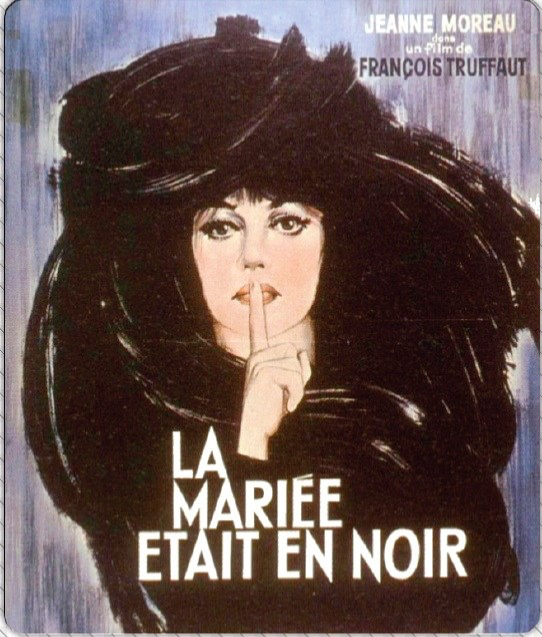
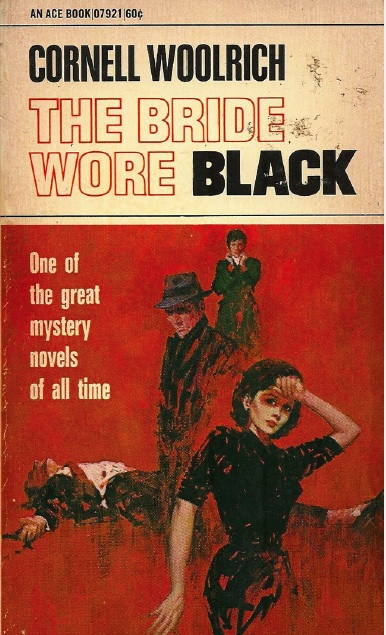
Moreau also starred in Francois Truffaut’s film, La Mariee Etait En Noir adapted from the noir classic, The Bride Wore Black by William Irish (Cornell Woolriich.) The Bride Wore Black is about a young woman named Julie, widowed on her wedding night, who methodically sets out to assassinate the men she believes killed her husband. She uses a variety of methods and disguises to accomplish her task. In the movie, she appears wearing either black or white or both.

LaMariee copyShe approaches her first victim, a womanizer, at a lavish party on the eve of his wedding. He is immediately intrigued and attracted to her. She connives to get him alone on a balcony where she tells him her name and pushes him over.

She poisons her next victim, a lonely bachelor, by luring him to a concert and then arraigning a rendezvous at his apartment the next night. She serves him a drink from a bottle of liquor which she has already spiked. She reveals her identity to him as he dies in agony.

Her third victim is a politician. She follows the man’s wife and son, befriends the boy and decoys the wife away. Then she poses as the boy’s teacher to gain access to the house. While in the house, she uses a ruse to trap the man in a tiny closet which she seals up. As he begs for his life, she reveals her identity. He suffocates in the closet.

The fourth man is an artist. Julie poses for him as the huntress Diana, eventually shooting him in the back with an arrow. She cuts out her face from the canvas he was painting in order to conceal her identity, but later she discovers he has painted a mural of her in the nude. She decides to leave the mural in place.

The final victim has been arrested and is in jail. She attends the artist’s funeral where she is arrested. Julie confesses to the murders, but refuses to reveal her motives. Julie is sent to prison, the women’s wing, and her intended victim is in the men’s wing. Julie gets a job in the kitchen. In the final scene, Julie is making the rounds with a serving cart on which she has hidden a knife. Julie and the cart turn a corner. After a brief pause, a man’s scream is heard.

Bride copyCornell Woolrich, 1903-1968, was a novelist and short-story writer. In the1940’s he established himself as one of the great mystery writers along with Earl Stanley Gardner, Raymond Chandler, and Dashiell Hammett. His stories, which tend to be dark, became noir classics. More of his stories have been adapted to the noir cinema than any other writer’s. He wrote The Bride Wore Black in 1940, which Truffaut brought to the screen in 1968. In 1969, Truffaut filmed Waltz Into Darkness as Mississippi Mermaid.

Woolrich’s 1942 story, It Had To Be Murder, was made into the Hitchcock film, Rear Window (1954). Woolrich struggled with illness, alcoholism, and self-doubt. He was tortured by guilt over homosexuality. After an attempt at screenwriting in Hollywood ended in 1933, Woolrich moved to New York where he lived with his mother and began writing pulp fiction. After his mother’s death in 1957, Woolrich went into decline and became a recluse. He did not attend the premiere of Truffaut’s film. La Mariee Etait En Noir, even though it was held in New York in 1968. He died shortly after.

I’m calling this an Aloha Friday post even though it comes on Sunday. There is news from Honolulu that a Hawaiian monk seal and her pup have taken up residence on Kaimana Beach (also known as San Souci Beach) near the Natatorium at the Diamond Head end of Waikiki. You can read the Star-Advertiser story here.

Why this is cool. First, monk seals are endemic to Hawaii and are protected. When one of them takes to a beach to bask in the sun, the state cordons off an area around the seal to give them peace. Sometimes the entire beach will be closed off if the beach is small. Second, monk seals tend to seek out secluded beaches when they have a pup with them, so it is rare to see a mother with a pup.

2017-03-15 11.09.24

Kaimana Beach in Waikiki with a view of the Natatorium and beyond the high rises of Waikiki, 3/15/17

Kaimana beach is one of our favorite beaches. When we lived in the Maliki area, we spent almost every Sunday at Kaimana. Usually, I would do a run from nearby Kapiolani Park and then meet Mary Fran and Ted, our son, at Kaimana at the end of the run. Often we would meet friends there. When we returned to Hawaii in March, we made it a point to visit Kaimana. It’s as lovely as ever.

2017-03-15 11.13.37

Kaimana Beach, Waikiki, 3/15/17

We did encounter monk seals at Poipu Beach on Kauai and the relatively secluded beach at Kalaupapa on Molokai. In both cases we  kept our distance, but especially at Kalaupapa because that seal had a pup with her. Mother monk seals can be very aggressive when they believe their pup to be threatened.

The Hawaiians have nicknamed the Waikiki pup, Kaimana, after the beach. She has become quite a celebrity and a huge cause for concern by both her mother and the locals when she wandered off. All ended happily when she was discovered in a corner of the Natatorium and returned to her mother.

2017-04-17 12.58.17

Monk seal and her pup on the beach at Kalaupapa, 4/17/17

It’s Aloha Friday, no work till Monday.

The Hawaii Excursion 2017

Waikiki Beach

View from the lanai of the Hilton Hawaiian Village, March 14, 2017

We arrived in Honolulu on March 13. First stop, the Hilton Hawaiian Village, located at the western end of Waikiki. The HHV is a huge complex of seven towers with restaurants, entertainment, shopping, and convention facilities. We had stayed there one night back in the 1980’s. We probably would not have chosen it had we not been there for Left Coast Crime, Honolulu Havoc. I have nothing against the HHV. Mary Fran and I are simply not resort people. We were very pleased and surprised with what we found. If you are doing a week-long Hawaiian getaway, the HHV is a great place with plenty to do for everyone, including kids. Best of all, it’s right on Waikiki Beach and an easy walk to some of the best restaurants and entertainment.


You don’t have to leave the Hilton for music. We heard the very talented Nohelani Cypriano one night in the beachside Tropics and we heard Jerry Santos and Olomana two nights in the Tapa Bar. Both Nohelani and Olomana are regular headliners at the Hilton. One of the Olomana performances,

Jerry Santos and Olomans

Jerry Santos (guitar) performing at The Tapa Bar, March 18, 2017

in particular, was a treat because it was the same night as the Kamehameha Schools Song Contest. We were in the Tapa Bar when the song contest finished and some of the judges came into the Tapa. A few of them performed some impromptu hulas.

Meals are expensive at the Hilton, as you might guess, but the Hilton Lagoon borders Waikiki Yacht Harbor and between the two is a parking lot where we found a great food truck with reasonably priced fish and shrimp tacos. On the other side of the Hilton is the Hale Koa, a hotel for servicemen and their families. You can’t get into the Hale Koa without a military ID, but there is an outside café and an outside bar, neither requiring IDs. The prices there are about half of the Hilton’s.

In coming weeks, I will post more about the conference and our Hawaii excursion.

Go For Broke

The Hilton Hawaiian Village is located next to Fort DeRussey where the Hale Koa Hotel is located as well as a military museum and Kuroda Field. The field is a large, green area commemorating Robert T. Kuroda, a Medal of Honor recipient who died in Bruyeres, France in 1944.

Kuroda Field, Ft. DeRussey

Honoring Robert T. Kuroda, Medal of Honor Recipient, 442nd RCT

Kuroda was a member of the 442nd Regimental Combat Team, the most decorated American combat unit. The motto of the 442nd was “Go For Broke.”

Following the Japanese attack on Pearl Harbor, the Japanese population in Hawaii came under suspicion and their loyalties were questioned. They responded by taking measures to support the war effort and to demonstrate their allegiance to the United States. Many Japanese-American men, mostly Hawaiian-born, petitioned to be allowed to serve in the military. Some of these men were already serving in various units of the Hawaii National Guard, others were members of the University of Hawaii ROTC who called themselves the Varsity Volunteers for Victory. Their petition was granted and they were organized into the 100th Infantry Battalion on June 5, 1942. By this time, Japanese American citizens living in the western portion of the United States were being rounded up and sent to concentration camps throughout the West.
The 100th was the first US Army unit made up of Japanese Americans. Most of these men were Nisei, or second-generation, whose parents had emigrated from Japan (and who were not eligible for citizenship until sometime in the 1950’s.) The 100th trained at Camp McCoy in Wisconsin and Camp Shelby in Mississippi. In 1943 the US government offered Japanese American men on the mainland an opportunity to leave the camps by joining the Army. Many volunteered and were formed into the 442nd which was merged with the 100th. The 100th became the 442nd’s first battalion.

While the 442nd trained at Camp Shelby, the 100th was sent to Oran in North Africa. From there they were sent to Salerno, Italy and took part in the Italian campaigns, The rest of the 442nd joined them in early 1944 and continued the fighting through Italy and southern France.

I will give more about the 100th and the 442nd in the coming weeks. As I mentioned above, Robert Toshio Kuroda, born in Aiea, Hawaii, enlisted in the Army and served in the 442nd. He was twenty-one years old when he died. Here is his Medal of Honor citation.

Staff Sergeant Robert T. Kuroda distinguished himself by extraordinary heroism in action, on 20 October 1944, near Bruyeres, France. Leading his men in an advance to destroy snipers and machine gun nests, Staff Sergeant Kuroda encountered heavy fire from enemy soldiers occupying a heavily wooded slope. Unable to pinpoint the hostile machine gun, he boldly made his way through heavy fire to the crest of the ridge. Once he located the machine gun, Staff Sergeant Kuroda advanced to a point within ten yards of the nest and killed three enemy gunners with grenades. He then fired clip after clip of rifle ammunition, killing or wounding at least three of the enemy. As he expended the last of his ammunition, he observed that an American officer had been struck by a burst of fire from a hostile machine gun located on an adjacent hill. Rushing to the officer’s assistance, he found that the officer had been killed. Picking up the officer’s submachine gun, Staff Sergeant Kuroda advanced through continuous fire toward a second machine gun emplacement and destroyed the position. As he turned to fire upon additional enemy soldiers, he was killed by a sniper. Staff Sergeant Kuroda’s courageous actions and indomitable fighting spirit ensured the destruction of enemy resistance in the sector. Staff Sergeant Kuroda’s extraordinary heroism and devotion to duty are in keeping with the highest traditions of military service and reflect great credit on him, his unit, and the United States Army.

In total, twenty-one members of the 442nd Regimental Combat Team were awarded Medals of Honor.

Aloha Roland Cazimero

Last week Hawaii and the world lost a great singer, song-writer, and composer. Roland Cazimero was a 1968 graduate of Kamehameha Schools. With his older brother Robert, he shared his gift of music with the world for more than forty years, winning many Na Hokuhanohano awards and influencing several generations of Hawaiian musicians. The brothers formed the band, Sunday Manoa, with Peter Moon and quickly emerged as leaders of the Hawaiian music, art, and cultural renaissance in the 1970’s. Later Robert and Roland performed and recorded as a duo, The Brothers Cazimero. For many years they headlined at the Monarch Room in the Royal Hawaiian Hotel. They were inducted into the Hawaiian Music Hall of Fame in 2006. Though we mourn his passing, his music will never die.

Say It Ain’t So, Hawaii Five-O

Sadly, it is so. Daniel Dae Kim and Grace Park have left the show. I don’t know how they can be replaced. Grace Park, as Kono Kalakaua was one of the most kick-ass women on screen. She surfed. She stood up for victims of abuse. She kicked ass and gave out more punishment than she took. Daniel Dae Kim had that look of confidence and quiet menace about him, that told you he meant business. When Marshall Zeringue asked who I would cast if The Splintered Paddle were made into a movie, I nominated Daniel Dae Kim to play Moon Ito. Hop over to the “About Ava Rome” page of this site for the link to My Book, the Movie.

Until next time, Aloha.


In this post I discuss the process that went/goes into revising the second novel in the Ava Rome series. The working title is Day Of Infamy, but I have not settled on that. I’ll leave that to another post. As of this writing, I have completed nine drafts of the manuscript and believe it is close to being finished. I expect at least one more draft, of mostly polishing.

The First Draft:

On July 15, 2016, I wrote “The End” to the final page of the first draft. When compiled into a single manuscript, it came to sixty-six chapters, six hundred fifty-one pages, 128,978 words (162,500 words according to the page count method. More on that later.)

The manuscript was a beast and the beast needed to be tamed. Clearly it was too long. How much needed to be eliminated? Typical mysteries run about 70,000 to 90,000 words, so I needed to eliminate at least 40,000 words, about 30%. Eliminating that many words seemed a daunting task, but at least I had a goal. I anticipated many drafts to get to that point. I hoped that no more than ten would be necessary.

The Plan:

I follow the Three-S system of revising—Story/Scene/Sentence. One draft for each, so the minimum number of drafts would be four. Each draft should be shorter than the next one. Let’s look at what goes into each.

Story:

Revising for story is where the biggest cuts are made. Stephen King said the second draft should be ten percent shorter that the first draft. I hoped for fifteen to twenty percent shorter. The first thing I examine is the story structure. Does the story fit the three-act structure? Are the act breaks clearly identifiable? Is there an inciting incident? Does the story have a compelling center point? Is the ending believable, inexorable, and satisfying? Does the story have a theme? Does the main character have an arc? Does she have inner and outer goals? Does she grow? Are there characters and subplots that can be eliminated? Are there seeds that produced nothing and can be pulled? Plot holes to be filled? Dead ends to be sealed off? Loose ends to be tied down?

Scene:

Scenes are where the action takes place. Scene-editing is done in the second step. Things to consider when revising scenes are setting, action, and sequel. Every scene takes place somewhere. The action must be set up before it can happen. The action is conflict and movement. The point of view character has a goal. Someone or something tries to thwart that goal. The POV character’s steps to reach that goal and reaction/response from the other side constitute the action. It can be told in dialogue or with action verbs. The goal is either attained or it is not. After every action comes a sequel. The sequel can be paragraphs or even pages long, or it can be as short as a single word. The sequel is a judgement or internalization or conclusion on the part of the POV character regarding the action that took place. How did she feel, what will she do as a result? What did she learn? Each scene should have a good mix of narration, dialogue, and introspection.

Finally, the sentence:

This is the third step because there is no need to work on sentences that might get cut from a scene in step two. This is where the writing is tightened up; adverbs are hunted down and eliminated; empty words and filler words are cut or replaced. In this stage, you remove or rewrite passive constructions. You vary the sentence length.

Getting to work:

Having set a goal and laid out a plan, my first step was to go through the manuscript and identify each scene. For each one, I wrote a one or two sentence description on a 3 X 5 index card. Many scene cards had already been created during the writing of the first draft. I would write them out when the idea hit me or else when I was planning out a scene. Some of those ideas did not make it into the first draft. Those, I discarded. Most of the cards represented scenes in the early part of the book when I did a lot of planning. The writing went easier and faster in the later part of the book—like running downhill. The cars for those scenes were the ones created after the fact.

Step two was to put the scene cards in their order in the first draft. Step three was to group the cards by act. I laid them out in order on a card table-one column each for the first act, the first half of the second act, the center point, the second half of the second act, and the third act.

Next post, the three acts.

. . . The Late Show, Michael Connelly’s latest novel, released last week. As a longtime fan of Michael Connelly, I’ve read all his books and eagerly waited for this one. Would this be another Harry Bosch? A Mickey Haller? Perhaps a Jack McCoy? None of the above. Connelly gives us someone new—LAPD detective Renee Ballard.

I have always admired Connelly’s female characters—Rachel Walling, Cassie Black, Eleanor Wish—but, except for Black, none appeared as the main protagonist. Walling, in my opinion, is one of the best female characters and deserves her own lead. Black is also an interesting character. I once had the opportunity at a book-signing, to ask Connelly if there would be another Black book. He said she’s getting too old for the type of things she does. Connelly, by the way, ages his characters in real time. Harry Bosch is at retirement age and Rachel Walling is nearly there.

But I digress. Here’s the dope on Renee Ballard. Ballard has ten years on the job as a detective in the Hollywood division. Not only is she a woman, she is a wahine, a Hawaiian, raised on Maui, graduate of Lahainaluna. High School, and a fellow alum of the University of Hawaii. When not detecting, she SUPs (stand up paddle boarding.) It is not clear if she is a kama’aina (native-born Hawaiian.) Her father was a surfer. His death by drowning twenty years earlier still haunts her dreams. Her mother is out of the picture. After graduating from UH Manoa with a degree in journalism, she did a brief stint as a crime reporter in LA. That experience convinced her to join the PD and become a detective. (With that background, you could call her a maka ikiu—detective in Hawaiian. Certainly a fitting topic for this Hawaiian Noir blog.)

Ballard resembles Bosch in some respects. She has problems with authority, is impatient with standard operating procedure and protocol, becomes defiant when challenged or blocked. She is ambitious in the way Bosch is ambitious—not for career advancement, but to clear cases and speak for the victim. The late show of the title refers to the night shift in the PD, the eleven to seven shift. Night shift detectives work the cases as they come in, but turn those cases over to the day detectives. They seldom have the opportunity to close cases. The late show is a career dead-end for a detective. Ballard was assigned to the late show after filing a complaint against her lieutenant. So, like Bosch, she has plenty of conflict with her superiors. The Late Show presents Ballard with a couple of cases she is determined to solve. I can’t give away the ending because I don’t know it yet. I’m anxious to get back to it. Ballard is a character I want to spend time with and hope Connelly gives us more. Hell, I’m jealous. Ballard is the kind of character I want to write.

One more thing. Connelly doesn’t make a big deal of this, but it appears that Ballard is homeless. Her home is van and a tent which she shares with her dog Lola.

Shelbi LeMeilleur reviews The Splintered Paddle in the March issue of Insite Magazine.

Here is what she has to say:

This novel is exhilarating, constantly changing directions and keeps the readers on their toes, trying to solve the mystery before Ava does. . . . Well, book a ticket to sunny Hawaii, and join Ava Rome on an adventure you won’t soon forget.

You can read the full review here.

– See more at: http://www.insitebrazosvalley.com/lifestyle/brazos-reads/brazos-reads-march-mystery/#sthash.ueOSGZvt.dpuf

Laura Hartman calls The Splintered Paddle, “heart-pounding Hawaiian mystery.” She says:

Troy does a great job blending the stories and solid believable characters with Hawaiian culture. Adding Ava’s past enriches the mix and pulls the readers closer to her, I’m keeping my fingers crossed for a sequel.

You can read the complete review here: https://writeknit.wordpress.com/2015/01/10/book-review-the-splintered-paddle-heart-pounding-hawaiian-mystery/